 Copy URL to Clipboard

A flatbed accessorial charge is an extra fee carriers add when a shipment requires services beyond standard pickup and delivery. Common accessorial charges include tarping, detention, layover, TONU, permit fees, and limited access charges, and this guide helps oversize shippers identify accessorial charges on a freight bill and prepare freight to avoid these fees.
A flatbed freight accessorial charge is an additional service fee to haul oversize freight, like trailer overhang or layover.
Accessorial charges are either time-based or surcharges. We’ve created a chart of the most common flatbed freight accessorial charges:
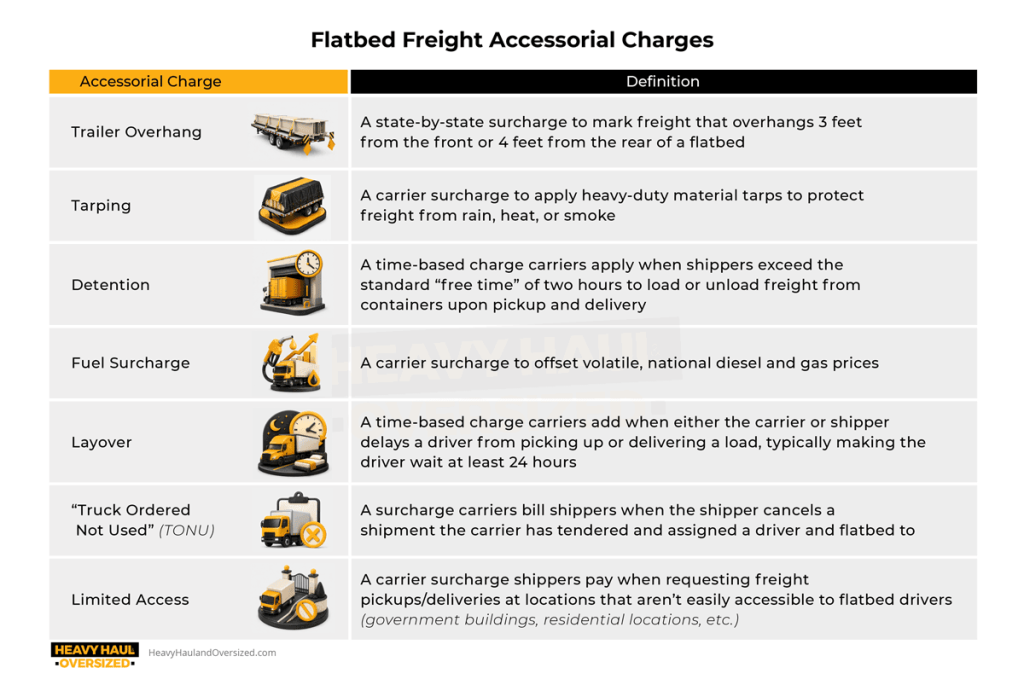
Like flatbed shipping rates, flatbed accessorial charges vary by carrier, service type, and commodity. For example, tarping fees for flatbed freight protection depend on your commodity’s height and length. Carriers will charge a tarping fee ranging between $100 to $150 per load.
Flatbed accessorial charges are different from carrier to carrier because the fees are triggered either by freight market volatility or discrepancies between the shipper and carrier.
Flatbed accessorial charges vary from other shipping modes, like full or less-than-truckload, because of the federal regulations for tarping, tiedowns, oversize/over-length freight, and overhang.
The Federal Motor Carrier Safety Administration (FMCSA) is an agency of the U.S. Department of Transportation (DOT) and oversees safe freight transportation in the United States. FMCSA requires shippers and carriers to obtain oversize/over-length permits from the state authority before moving heavy loads as prices vary by state and load type.
Each state also has its own penalties for noncompliance, such as Texas that fines shippers and carriers up to $200 per overweight violation.
In the next sections, we’ll discuss how breaking FMCSA Cargo Securement Rules can lead to flatbed accessorial rates.
FMCSA Cargo Securement Rules require blocking and bracing techniques to load flatbed freight. Block and brace is a cargo securement technique that uses wooden chocks to block or tiedowns to brace freight on the flatbed and prevent shifting or crushing other freight in transit.
The working load limit (WLL) is the maximum weight a piece of loading equipment, like tiedowns, can safely handle. According to 49 CFR § 393.108, the WLL of a tiedown to secure freight on a flatbed must match the tiedown manufacturer’s labels.
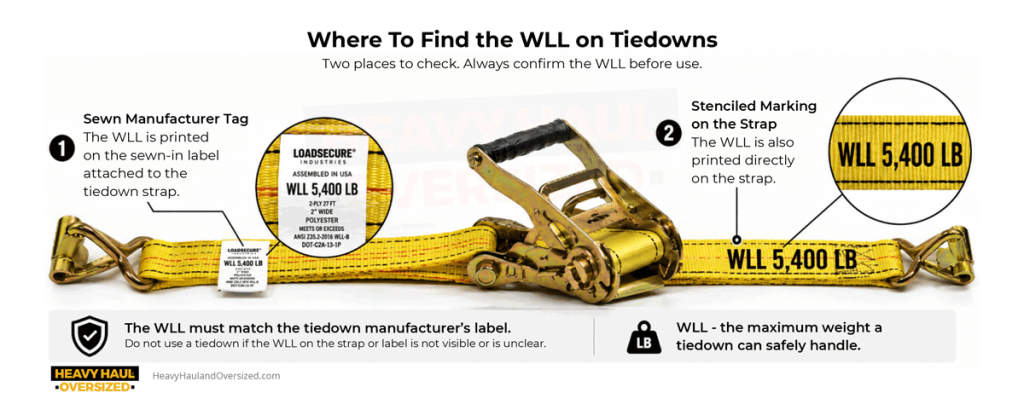
Tiedown materials to secure flatbed loads are:
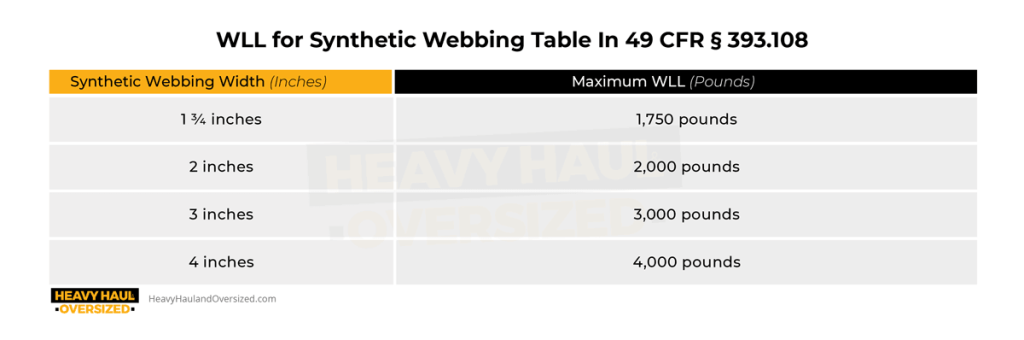
Shippers and carriers can also use the 49 CFR § 393.108 Tables to find the WLL for the specific material their tiedown is made from, like chains and synthetic webbing.
Other required flatbed loading/unloading equipment are tarps. A flatbed tarp is a heavy-duty material used to blanket and protect freight from weather damage like rain, heat, and snow.
Tarps can be made of polyester, steel, or mesh and weigh more than 100 pounds based on the material. Your carrier will determine the necessary material and size tarp to secure your load depending on the commodity and its size.
FMCSA requires securement devices for flatbed loads to keep freight from shifting and slipping off the trailer in transit.
Tarps and tiedowns are necessary to secure freight and FMCSA requires at least one tiedown for freight five feet or less in length and 1,100 pounds or less in weight. Freight that is greater than five feet or less than 10 feet in length and over 1,100 pounds requires two tiedowns.
Improper load securement can lead to DOT fines ranging from $1,000 to $10,000 per violation.
Flatbeds typically haul oversize/over-length loads which can trigger accessorial fees like detention, layover, and TONU if shippers do not plan or specify shipment details with their carrier.
In the next section, we’ll discuss how to coordinate with your carrier to avoid these fees.
Shippers can avoid flatbed accessorial charges by providing their carrier accurate shipment details, such as pickup/dropoff dates, freight pallet count, and weight distribution requirements.
Prepare your next flatbed quote with our checklist to ship your goods without the extra fees.
Accessorial charges vary from carrier to carrier, so be sure to speak with your freight professional about the fees included in your shipment vs. what to steer clear of, like detention fees.
If you disagree with an accessorial on your freight bill, here’s how to work with your carrier to resolve the issue with evidence.
Shippers should present this information to their carrier in an email or written letter sent through the carrier’s transportation management system (TMS) to track progress of dispute status.
Flatbed accessorial charges vary by equipment, freight details, and shipping lanes. Call (866) 902-2713 to speak with a member of our oversize freight team or grab a flatbed quote today.
Sources:
Cargo Securement Rules, FMCSA, 2014
Appendix B: Summary of State Exceptions to Federal Truck Weight Limits, FHWA
Oversize/Overweight Permitting, FMCSA, 2014
Special Provisions and Exceptions for Oversize or Overweight Vehicles, Texas Department of Public Safety, 2020
49 CFR § 393.108, Code of Federal Regulations, 2026
49 CFR § 370.5, Code of Federal Regulations, 2026
The Standard That Keeps Freight Moving, NMFTA
Heavy Haul and Oversized
315 NE 14th Street #4122
Ocala, FL 34470
