 Copy URL to Clipboard

Key Takeaway:
A flatbed is a standard open-deck trailer with one level. A step-deck, also called a drop-deck, has two deck levels that allow taller freight to ride lower and stay within legal height limits. This guide explains when to use each trailer, how securement differs, and which accessorial charges can affect shipping cost.
A flatbed is an open deck trailer with a single, flat surface used to transport oversized or over-length freight. A step-deck is an open, two-deck trailer used to haul oversized, over-length, and over-height freight.
We’ve made a comparison chart to detail the main differences of these two shipping modes:
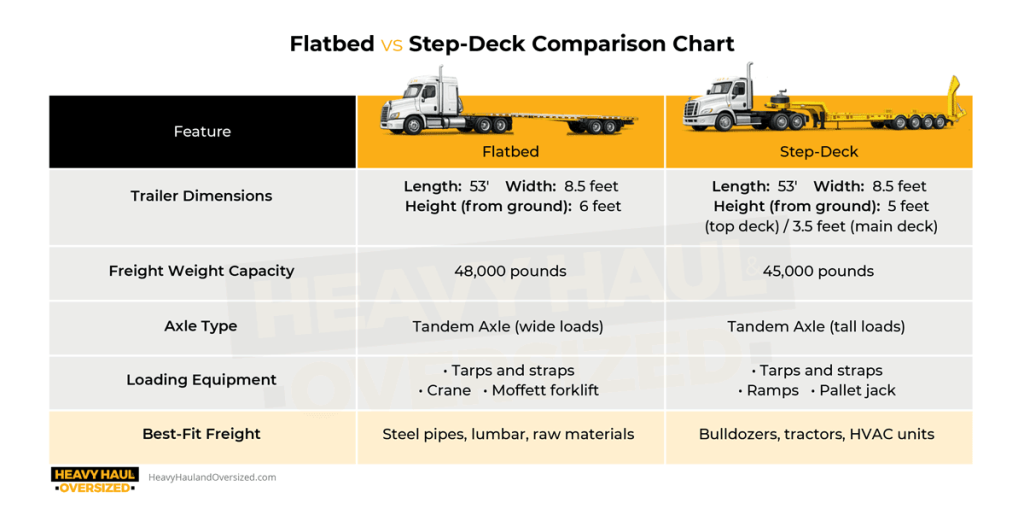
Flatbed and step-deck trailers roll on tandem, or dual, axles. These axles typically have a legal weight capacity of 34,000 pounds. Keep in mind that payload varies by axle configuration and state rules.
Step-decks, also known as drop decks, have a lighter freight weight capacity because step-decks are generally heavier than flatbeds. Step-decks also accommodate taller freight easier because the main deck sits lower to the ground.
Use a flatbed when:
Use a step-deck when:
In the next section, we’ll cover how to properly secure your load to haul on a flatbed or step-deck to comply with state and federal regulations.
Whether you’re shipping on a flatbed or a step-deck, oversized cargo transportation typically requires special permitting and warning flags to travel.
According to 49 CFR § 393.87, loads that extend beyond four inches of the sides or four feet beyond the rear of a trailer must be marked with a warning flag at the point of overhang. Trailer overhang regulations vary based on each state’s Department of Transportation (DOT).
Shippers seeking cost and delivery control to avoid additional fees, known as accessorial charges, can secure their loads by complying with state and federal regulations. We’ll review these regulations in the following sections.
The Federal Motor Carrier Safety Administration (FMCSA) is an agency of DOT that oversees safe freight transit. Shippers must comply with FMCSA Cargo Securement Rules to ensure the load is safe for travel, especially if the load exceeds the flatbed or step-deck legal freight weight.
FMCSA requires shippers to obtain permits for oversized/over-length loads when the load weight exceeds federal maximums.
FMCSA oversized/over-length weight limits are:
If a load exceeds these limits, shippers must obtain a permit through their state, not the FMCSA. Permit fees vary based on the state, type of permit, size, and weight of the load. The fee can be as low as $15 per single trip or as high as $500 per multiple trips a year.
Shippers will need one of the three heavy haul permits. We’ve created a chart for you to find the best permit that fits your flatbed or step-deck load.
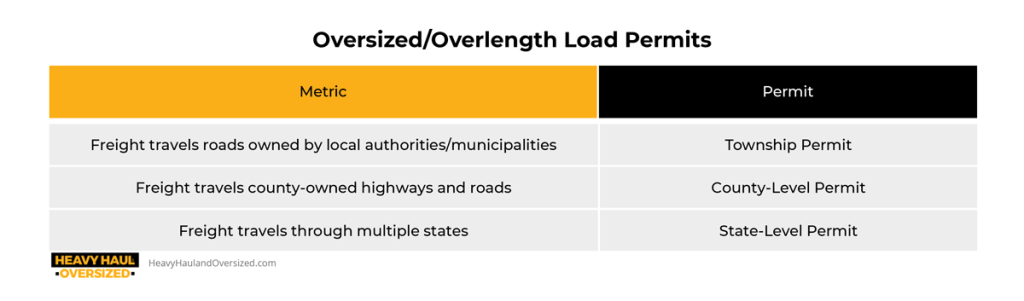
Shippers can apply for oversized/over-length load permits for single or annual trips. If you’re moving a heavy load just once or on a routine schedule, you’ll need permits and the appropriate equipment to secure your freight.
Freight riding on a flatbed or step-deck is secured with the following equipment:
Flatbeds and step-decks have similar securement points but your freight provider will recommend the best load strategy to protect your cargo from pickup to delivery.
Flatbeds and step-decks are great for hauling large, bulky, or awkwardly-shaped freight. Here’s what to provide your carrier to ensure they match you with the best trailer for your freight.
Let’s start with the shipping documents you’ll need for flatbed or step-deck loads:
Next, let’s determine if your load is divisible or non-divisible.
Shippers should obtain a permit for either type of load when applicable before booking a lane so the carrier can provide the best-fit trailer for the load.
Shippers who provide accurate details about their freight, origin location, and destination help carriers price their load and reduce the chance of accessorial fees. Let’s discuss what those fees are in the next section.
Flatbed and step-deck accessorial charges are extra fees added to the base heavy haul shipping rate for services or shipment conditions such as fuel surcharges, tarping, detention, permits, and reweighs.
Let’s look at the most common charges.
A fuel surcharge is a supplemental fee to offset volatile national fuel costs. Flatbeds and step-decks generally use more fuel to haul larger loads, which can increase the amount of a fuel surcharge. However, fuel costs are already included in shipping fees and carriers add the fuel surcharge in a shipper’s freight bill to protect their margins.
Reweigh and reclassification fees are more common on LTL shipments, but they still affect pricing when shipment details are incorrect. Accurate weight, dimensions, and NMFC information help carriers quote the load correctly and select the best-fit trailer.
Freight classification is reserved for LTL loads to define a shipment’s density per cubic foot and National Motor Freight Classification (NMFC) code for appropriate stowing and handling.
Choose a flatbed for freight that’s wide, crane-loaded, or does not need to lower deck height. Choose a step-deck for freight that’s too tall for a standard flatbed, but still needs open-deck transport.
Keep these factors in mind:
Inaccurate freight details can delay pickup, billing, and dispatch.
Accurate dimensions, handling details, and receiving location information help carriers match the shipment to the correct trailer and reduce avoidable delays or added charges.
Use this quote-ready checklist to avoid accessorial charges and prepare for heavy haul shipping requirements.
Flatbeds are often the better fit for wide freight and top-down crane loading, while step-decks are better suited for taller freight that needs lower deck height.
Providing accurate shipment details up front helps carriers match the right trailer and reduce avoidable delays or added charges. If you’re not sure whether your shipment needs a flatbed or a step-deck, talk with our team. We can review your freight details and help you choose the right trailer before you book.
Call us at (866) 902-2713, risk-free and no obligation.
Sources:
Oversize/Overweight Permitting, FMCSA
Cargo Securement Rules, FMCSA
49 CFR § 393.87 - Warning flags on projecting loads
National Motor Freight Classification (NMFC), NMFTA
Heavy Haul and Oversized
315 NE 14th Street #4122
Ocala, FL 34470
