 Copy URL to Clipboard

Heavy haul shipping regulations are the federal and state rules that govern the movement of overweight and oversize freight in the United States. Shippers and carriers use these rules to determine permit requirements, route restrictions, safety equipment, and load documentation before transporting heavy haul freight.
Heavy haul freight is cargo that exceeds standard legal limits for weight, width, height, length, or axle load. When freight crosses those thresholds, carriers usually need special permits, approved routes, and equipment that complies with state and federal transport rules.
We’ve created a chart of freight that is commonly classified as heavy haul.
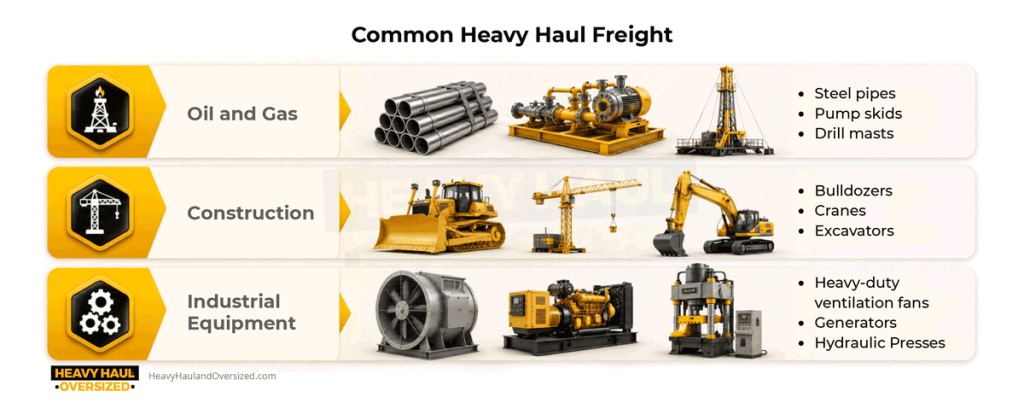
As the chart depicts, bulldozer transport often qualifies as heavy haul because even a small bulldozer can weigh up to 29,000 pounds. This means heavy haul carriers need to own the appropriate trailers and equipment to safely load and transport oversize freight.
Although all U.S. states operate under U.S. Department of Transportation (DOT) requirements, transportation regulations can vary by state. However, state regulations cannot conflict with or unreasonably burden the federal requirements established under Title 49 of the United States Code (U.S.C.) and Title 49 of the Code of Federal Regulations (CFR).
For example, the Federal Highway Administration (FHWA) is an agency of DOT and outlines federally mandated maximum weights for oversize/overweight loads. While the FHWA lists the following thresholds for heavy haul loads, it doesn’t issue permits for oversize/overweight vehicles. Instead, all 50 states require the use of oversize/weight load permits to protect drivers and road conditions.
Thankfully, most state heavy haul shipping regulations are similar, allowing shippers and carriers to plan oversize freight transportation across multiple states without hassle.
We’ve made a chart of the federal maximum weight and width for commercial motor vehicles (CMV) like truck-tractors and semi-trailers traveling on the Interstate National Network (NN) of highways and routes.
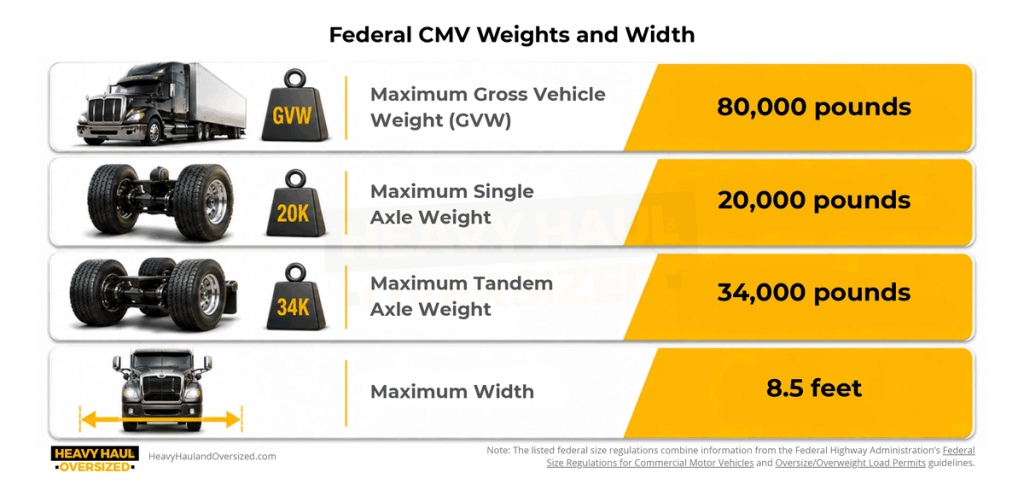
Note: The listed federal size regulations combine information from the Federal Highway Administration’s Federal Size Regulations for Commercial Motor Vehicles and Oversize/Overweight Load Permits guidelines.
There is no federal length or height requirement for CMVs. States set their individual height regulations, generally from 13 feet, 6 inches to 14 feet for height.
When CMVs and the freight they haul exceed these federal maximums, including trailer overhang, it’s considered overweight/overwidth/oversize, and carriers must obtain a permit to haul it on NN highways and roads. We’ll discuss how to obtain an oversize freight permit and the information required to apply.
Shippers obtain oversize load permits from each state, county, or municipality their route crosses, because permit authority is issued locally rather than by FHWA. Applications usually require load dimensions, axle weight, commodity details, origin, destination, and the planned freight route.
While each state has its own oversize load qualifications, shippers will need the following shipment information to apply for oversize load permits and comply with heavy haul shipping regulations.
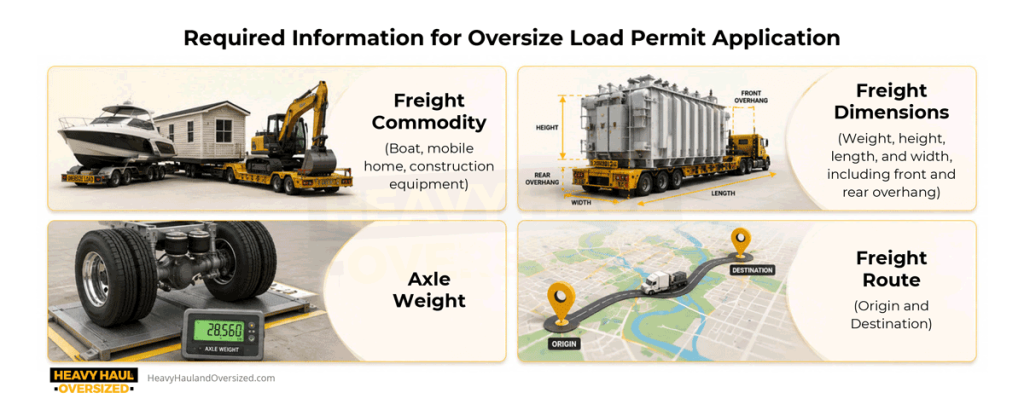
A freight route is a path of roads, highways, and bridges to move a shipment from its origin to its destination. The roads in a route are owned by local authorities or municipalities, counties, or the state you wish to move goods through.
Depending on your route, you will need one of the following permits:
Oversize load permits can be used for single or annual trips.
Single trip permits may cost up to $200 per state, while annual trips can cost more than $1,000 per state, both costs depending on the state and freight route plan.
States may offer superload permits for heavy haul freight that exceeds 200,000 pounds, 16 feet in height, and 16 feet in width. Superloads require specialized loading equipment, flags, banners, lights, pilot cars, and even local authorities to help navigate routes safely.
Oversize loads will typically need the same signage, depending on the height, weight, and length of the load. In the next section, we’ll review the required safety equipment to haul oversize loads.
Whether you’re hauling a wide load or oversize load, shippers must include the state-required safety equipment and signage in the total cost of heavy haul shipping.
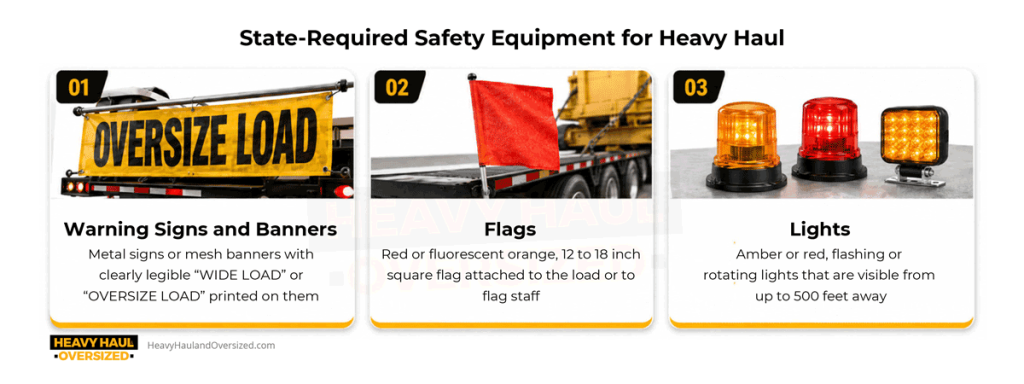
Lights on heavy haul loads must be placed in the same orientations as its flags. Some states, including Florida and Georgia, will require semi-trucks to have an additional light on top of the cab.
A pilot car is an escort vehicle to guide oversize loads through roads and highways. Pilot cars can be compact cars, SUVs, or pickup trucks with safety signage attached to notify drivers they are en route with the oversize load.
Depending on the size of the load, one or multiple pilot cars, including law enforcement, may drive alongside, in front, or behind the semi-truck.
Pilot cars, signage, and the appropriate trailer, like flatbeds, are required to comply with heavy haul shipping regulations and transport freight seamlessly from one point to the next.
Heavy haul moves depend on accurate permits, route planning, and the right safety equipment. If you need help planning an oversize shipment, request a heavy haul freight quote or call (855) 490-2433 to speak with a shipping specialist.
Sources:
U.S. Code: Title 49 — TRANSPORTATION
Title 49 — Transportation, CFR
Vehicle Configuration and Cargo Body Types: Truck Tractors and Semi-Trailers, FMCSA
Federal Size Regulations for Commercial Motor Vehicles, DOT & FHWA
Oversize/Overweight Load Permits, FHWA
Heavy Haul and Oversized
315 NE 14th Street #4122
Ocala, FL 34470
